How to Defend Against Software Supply Chain Attacks: Lessons from the CPU-Z Watering Hole Incident
Introduction
On April 9, 2026, a sophisticated supply chain attack targeted the popular CPU-Z utility. The official CPUID website, cpuid.com, was compromised at the API level. For 19 hours, visitors who clicked the legitimate download button received a properly signed binary containing a hidden malicious payload. This incident demonstrates that even trusted software vendors can become unwitting delivery channels for malware. Understanding how this attack unfolded—and how SentinelOne's AI-powered EDR autonomously blocked it—provides a blueprint for strengthening your own software supply chain defenses. This guide walks you through the key steps to detect and prevent similar attacks on your network.
What You Need
- Endpoint Detection and Response (EDR) solution with behavioral AI (e.g., SentinelOne)
- Network monitoring tools capable of inspecting API calls and download origins
- Updated software inventory of all third-party applications in use
- Security awareness training materials for IT staff and end users
- Incident response playbook for supply chain compromise scenarios
- Access to threat intelligence feeds (e.g., annual threat reports)
Step-by-Step Guide
Step 1: Understand the Trust Chain Vulnerability
The CPU-Z attack exploited a fundamental flaw: users trusted the vendor's infrastructure, but that trust was misplaced. Threat actors compromised the download API, so even a genuine digital signature and official download link delivered malware. Recognize that your trust chain extends beyond your organization—it includes every third-party software source, their code repositories, and distribution pipelines. The key takeaway: security perimeters must validate not just the file, but the entire delivery process.
Step 2: Detect Anomalous Process Behavior
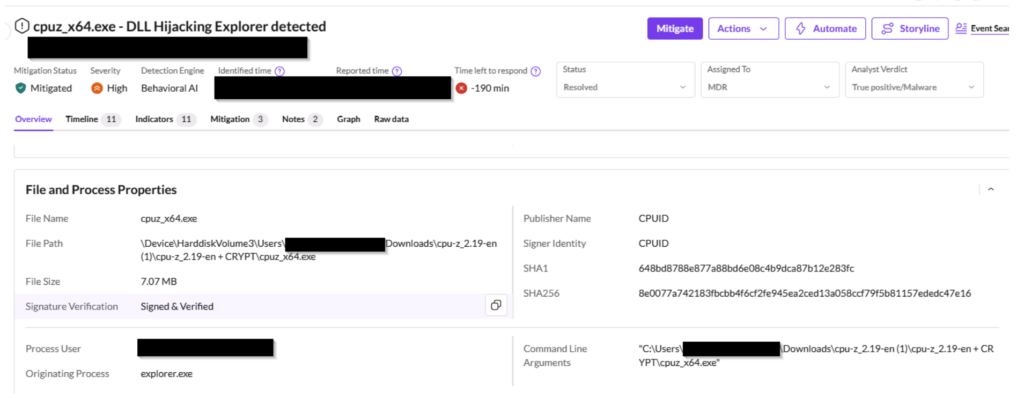
In the CPU-Z incident, SentinelOne flagged the malware within seconds because of odd process chains. Specifically, the cpuz_x64.exe binary—though legitimately signed— spawned PowerShell, which then launched csc.exe (C# compiler) and cvtres.exe (resource converter). CPU-Z never uses those tools. To replicate this capability:
- Implement behavioral baselines for each software application in your environment.
- Configure your EDR to alert on unexpected parent-child process relationships.
- Use process tree analysis to quickly identify deviations.
Step 3: Monitor for Reflective Code Loading and Memory Anomalies
The malicious payload in CPU-Z executed via reflective code loading—code running in memory without a corresponding file on disk. SentinelOne detected five specific indicators that you should monitor for:
- Anomalous API resolution: The process bypassed the OS loader to locate system functions.
- Reflective code loading: Executable code in memory regions with no file on disk.
- Suspicious memory allocation: Request for Read-Write-Execute (RWX) permissions.
- Process injection patterns: Code redirected into a secondary process to hide its origin.
- Heuristic shellcode signatures: Sequential operations typical of automated exploitation toolkits.
Tip: Enable memory scanning features in your EDR and set alerts for any combination of these indicators.
Step 4: Automate Quarantine and Termination
Upon detecting the anomalies, SentinelOne's AI agent autonomously terminated and quarantined the involved processes. This prevented the attack from escalating. To achieve similar automation:
- Define automatic response actions for high-confidence alerts (e.g., kill process, isolate endpoint).
- Use playbook automation to trigger containment without human delay.
- Ensure your EDR can distinguish between false positives and genuine threats by leveraging behavior-based detection.
Step 5: Investigate the Full Attack Chain
After containment, trace the attack back to its origin. In the CPU-Z case, the malicious payload was placed as the legitimate CRYPTBASE.dll file in the binary's folder. Your investigation should include:
- Reviewing DNS and API logs to see where the download was redirected.
- Checking file integrity against vendor baseline hashes.
- Analyzing process timelines to understand what PowerShell scripts were executed.
- Correlating with threat intelligence to identify if the attacker has targeted other vendors.
Step 6: Apply Lessons to Third-Party Software Management
The SentinelOne Annual Threat Report highlights a systemic shift: attackers now compromise developer identities and distribution infrastructure. The GhostAction campaign (late 2025) involved a compromised GitHub maintainer account pushing malicious workflows. Similarly, a phishing attack on an NPM package maintainer deployed code intercepting cryptocurrency transactions. To protect your supply chain:
- Implement vendor risk assessments with security questionnaires.
- Use software composition analysis (SCA) to identify dependencies.
- Require multi-factor authentication (MFA) for all third-party service accounts.
- Monitor for unusual commit logs or push events from trusted sources.
Step 7: Educate Users and IT Staff
Users who downloaded CPU-Z during the incident followed every standard instruction—the trust chain broke above them. The next attack will work the same way. Therefore:
- Train users to verify software sources even from known vendors (e.g., check official download pages for irregularities).
- Teach IT staff to recognize watering hole attacks and supply chain compromise signs.
- Conduct regular tabletop exercises simulating a vendor compromise scenario.
Tips for Ongoing Protection
- Adopt a zero-trust approach to software downloads: never assume a file is safe just because it's from a trusted vendor.
- Enable behavioral AI in your EDR to catch novel attacks that signature-based tools miss.
- Monitor for newly observed patterns (e.g., attacks that compromise distribution APIs) in threat intelligence feeds.
- Regularly review third-party software access and revoke stale permissions.
- Test your incident response plan with a mock supply chain attack at least annually.
By following these steps, you can build a resilient defense against the growing threat of software supply chain attacks. The CPU-Z incident shows that even a perfectly signed binary from an official source can be malicious—but with the right detection and automation, you can stop it before it spreads.
Related Discussions