6 Surprising Insights from MAVEN’s First Detection of a Space-Weather Effect in Mars’ Atmosphere
In December 2023, scientists poring over data from NASA’s MAVEN spacecraft were in for a shock. They spotted something never before seen in the Martian atmosphere: the Zwan-Wolf effect, a phenomenon long known to occur in Earth’s magnetic bubble. The finding, published in Nature Communications, reveals that charged particles in Mars’ upper air can be squeezed like toothpaste along invisible magnetic tubes, reshaping how we understand the Red Planet’s interaction with the solar wind. Here are six key takeaways from this groundbreaking study.
1. An Accidental Discovery That Rewrote the Playbook
Christopher Fowler, the study’s lead author from West Virginia University, was analyzing MAVEN magnetic field readings when he noticed odd wiggles in the data. “I would never have guessed it would be this effect, since it’s never been seen in a planetary atmosphere before,” he said. The team had set out to study space weather impacts, not to find a classic magnetospheric process inside Mars’ ionosphere. This serendipitous observation turned a routine data check into a first-of-its-kind detection, proving that even well-studied planets can still surprise us.
2. The Zwan-Wolf Effect: A Solar-Wind Deflector at Earth, a Squeezing Force at Mars
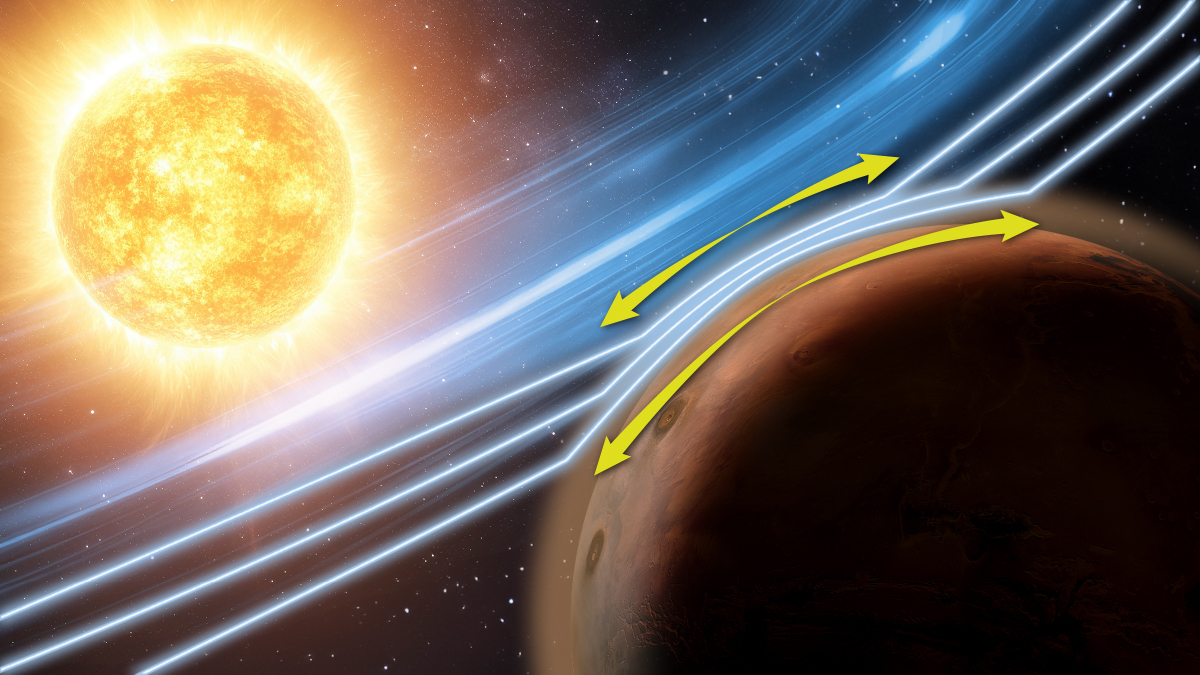
First predicted in 1976, the Zwan-Wolf effect describes how charged particles (ions and electrons) get trapped along magnetic flux tubes—think of them as hollow highways of magnetism. As solar wind crashes into Earth’s global magnetic field, these tubes compress the particles, shooting them sideways and helping deflect the incoming stream. At Mars, which lacks a global magnetic field, the same effect works differently: it squeezes the ionosphere itself, pushing ionized gas around the planet’s flanks. This new observation shows that the effect can occur deep in an atmosphere, not just in a magnetosphere.
3. Deep Inside Mars’ Atmosphere—Below 200 km
Unlike Earth’s magnetosphere, where the effect had been seen for decades, the Martian version takes place much lower—in the ionosphere, at altitudes below 200 km (124 miles). This region is rich in charged particles thanks to solar ultraviolet and X-ray ionization. The MAVEN data revealed that these particles were being systematically compressed and redistributed along flux tubes. Because Mars’ induced magnetosphere (created by solar wind interacting with its ionosphere) is weak and variable, the effect seems to become visible only during intense space weather events.
4. A Solar Storm Amplified the Signal
The MAVEN observations coincided with a large solar storm hitting Mars. Normally, the Zwan-Wolf effect might be too subtle for the spacecraft’s instruments to detect. But the storm’s enhanced solar wind pressure amplified the squeezing, making the magnetic field fluctuations and particle redistribution much more pronounced. The team now suspects the effect occurs constantly at low levels—it’s just invisible to current sensors. This storm provided a natural magnifying glass, allowing scientists to finally catch a glimpse of a process that could be shaping Mars’ atmosphere every day.
5. How MAVEN Pieced Together the Puzzle
To confirm the Zwan-Wolf effect, Fowler and his team didn’t rely on one instrument alone. They cross-referenced magnetic field readings from MAVEN’s magnetometer with ion and electron measurements from its Langmuir Probe and Solar Wind Ion Analyzer. By tracking how the particles moved and the field lines twisted, they reconstructed a coherent picture: charged particles being squeezed out of flux tubes and funneled around the planet. This multi-instrument detective work was essential, because no single data set could uniquely identify the effect.
6. Implications for Mars’ Atmosphere and Future Missions
Understanding the Zwan-Wolf effect at Mars matters for more than just academic curiosity. It could influence how solar wind strips away the Martian atmosphere over geological time, and how space weather affects future human explorers. For example, if the effect enhances atmospheric loss during storms, astronauts on the surface might need extra shielding. MAVEN continues to orbit Mars, and scientists plan to look for more instances of this squeezing phenomenon—especially during quiet times—to see if it’s a hidden, constant player in the planet’s space-weather dynamics.
In short, the first detection of the Zwan-Wolf effect in an atmosphere opens a new chapter in comparative planetology. It shows that processes we thought were unique to magnetized worlds like Earth can occur elsewhere, and it reminds us that even well-trafficked spacecraft can stumble onto something completely unexpected.
Related Discussions